When More Becomes Less: The Real Price of IT Sprawl in Mid-Sized Organizations
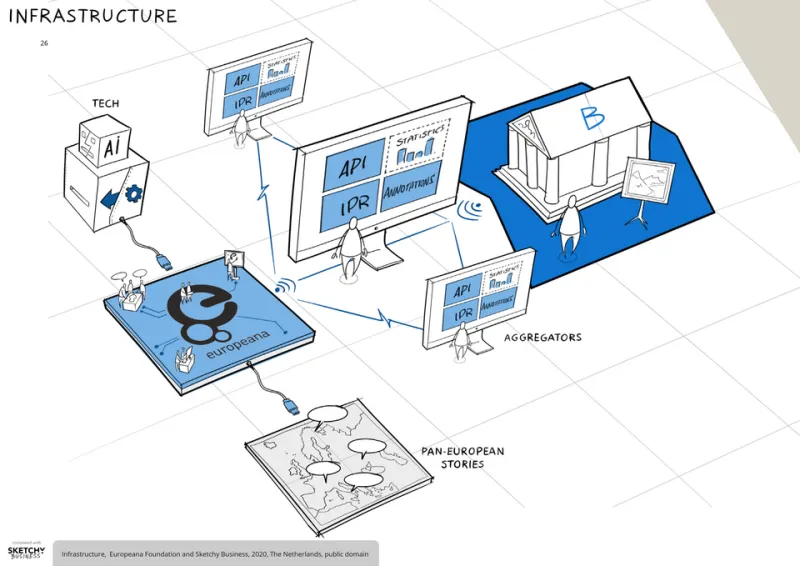
Photo: Europeana Foundation and Sketchy Business, CC0, via Wikimedia Commons
The Accumulation Problem No One Talks About
Growth is rarely tidy. For most mid-sized American companies, the technology stack reflects years of departmental decisions, legacy migrations, emergency purchases, and vendor renewals that nobody thought to question. The result is what IT professionals call "sprawl"—a fragmented ecosystem of overlapping tools, redundant licenses, and disconnected infrastructure that costs far more to maintain than leadership typically realizes.
According to industry research, organizations with between 200 and 2,500 employees spend an average of 15 to 25 percent of their IT budgets on software they either underutilize or duplicate across departments. That figure rarely appears on a single line item. Instead, it hides across procurement invoices, departmental credit card statements, and auto-renewed SaaS subscriptions that no one has reviewed in eighteen months.
Understanding the full scope of this problem is the first step toward reclaiming both financial and operational efficiency.
What IT Sprawl Actually Looks Like
IT sprawl does not announce itself. It accumulates gradually, driven by legitimate business needs that were never revisited once circumstances changed. A marketing team subscribes to a project management platform because the company-wide solution "doesn't work for them." A regional office maintains its own backup vendor because the central IT team was slow to respond during a critical deadline. An acquired subsidiary brings an entirely separate productivity suite that runs parallel to the corporate standard.
Each of these scenarios seems reasonable in isolation. Collectively, they produce several categories of waste:
Redundant Software Licenses: It is not uncommon for mid-market organizations to pay for two or three tools that perform substantially the same function—separate video conferencing platforms, duplicate CRM systems, or overlapping endpoint protection suites. Each carries its own licensing cost, administrative overhead, and security footprint.
Fragmented Infrastructure: When server environments, cloud tenancies, and networking equipment are procured piecemeal over time, integration complexity multiplies. IT teams spend disproportionate hours maintaining compatibility rather than improving capability.
Overlapping Vendor Relationships: Managing twelve vendors when four would suffice introduces hidden costs in contract negotiation time, support ticket routing, compliance verification, and vendor management labor. Each relationship requires attention that could otherwise be directed toward strategic initiatives.
Shadow IT: When employees adopt unauthorized tools to fill gaps in the official stack, organizations lose visibility into data flows, security posture, and spend. Shadow IT is both a symptom of sprawl and a contributor to it.
Building a Technology Spend Audit
Before a consolidation strategy can be designed, leadership needs an accurate picture of what the organization actually has. A structured audit is the foundation of that picture.
Step 1 — Inventory All Active Subscriptions and Licenses
Begin by pulling invoices, purchase orders, and credit card statements from the past twenty-four months. Include every department, not just IT. Finance, HR, sales, and operations frequently carry their own software expenses outside the central IT budget. Cloud provider billing dashboards—AWS, Microsoft Azure, and Google Cloud—should be reviewed for dormant resources, unattached storage volumes, and orphaned virtual machines.
Step 2 — Map Tools to Business Functions
Once the inventory is assembled, categorize each tool by its primary business function: communication, project management, security, data storage, analytics, and so on. Overlap becomes immediately visible when tools are grouped this way. Organizations frequently discover three tools performing the same function across different teams with no coordination between them.
Step 3 — Calculate True Cost of Ownership
License fees represent only a portion of what each tool actually costs. True cost of ownership includes IT staff time spent on administration and support, training and onboarding for new users, integration development required to connect the tool to other systems, and the compliance burden associated with each vendor relationship. A $300-per-month SaaS subscription may carry $1,200 per month in associated labor and integration costs once those factors are accounted for.
Step 4 — Assess Utilization Rates
Most enterprise software platforms provide usage analytics. Pull active user counts against licensed seat counts. Identify tools where fewer than 60 percent of licensed users have logged in within the past ninety days. Low utilization is not always grounds for elimination, but it is always grounds for review.
The Financial Case for Consolidation
Consolidation is not simply about cutting costs—it is about redirecting spend toward technology that generates measurable business value. That distinction matters when making the case to executive leadership and the board.
Consider a representative example: a manufacturing company with 400 employees and $2.8 million in annual IT spending. After a structured audit, the organization identifies $340,000 in redundant software licenses across six overlapping platforms, $95,000 in unused cloud resources, and $180,000 in labor costs associated with managing seventeen separate vendor relationships. Consolidating to a rationalized stack and a reduced vendor roster yields approximately $520,000 in annual savings—an 18.5 percent reduction in total IT spend—while simultaneously reducing the organization's security attack surface and improving support response times.
Those numbers are not atypical. Companies that undergo deliberate IT consolidation programs consistently report cost reductions in the 15 to 25 percent range, alongside meaningful improvements in system reliability and employee productivity.
Operational Benefits Beyond the Budget
Financial savings, while significant, represent only part of the consolidation dividend. Organizations that rationalize their technology footprint also experience:
- Reduced security exposure: Fewer tools mean fewer potential entry points for threat actors, fewer credentials to manage, and a smaller compliance surface to audit.
- Faster onboarding: New employees learn a streamlined, standardized stack more quickly than a fragmented one, reducing time-to-productivity.
- Improved IT responsiveness: Support teams that manage fewer platforms can develop deeper expertise and resolve issues more efficiently.
- Stronger vendor leverage: Consolidating spend with a smaller number of strategic partners typically yields better contract terms, priority support tiers, and more favorable renewal conditions.
Making the Business Case Internally
Consolidation initiatives require executive sponsorship to succeed. The most effective internal arguments combine financial projections with operational risk framing. Present the true cost of ownership analysis alongside the risk exposure associated with maintaining sprawl—particularly the compliance and security implications that resonate with boards and general counsel.
A phased approach often secures broader organizational buy-in than a wholesale replacement program. Beginning with the highest-cost redundancies and the clearest overlaps demonstrates early ROI, builds credibility for subsequent phases, and limits the disruption that can generate resistance from departmental stakeholders.
A Simpler Path Forward
IT sprawl is not a failure of intent—it is a predictable outcome of organizational growth without consistent governance. Addressing it requires a structured methodology, honest visibility into current spend, and a strategic vision for what a rationalized technology environment should look like.
The organizations that invest in that process consistently find that simplification is not just a cost-cutting measure. It is a competitive advantage. Leaner, better-integrated infrastructure supports faster decision-making, more agile operations, and a security posture that scales with the business rather than against it.
Enterprise IT, when managed with discipline and clarity, does not need to be complicated to be effective. That is a principle worth building around.